Tuesday, January 20, 2015

In The Details

Pg. 22
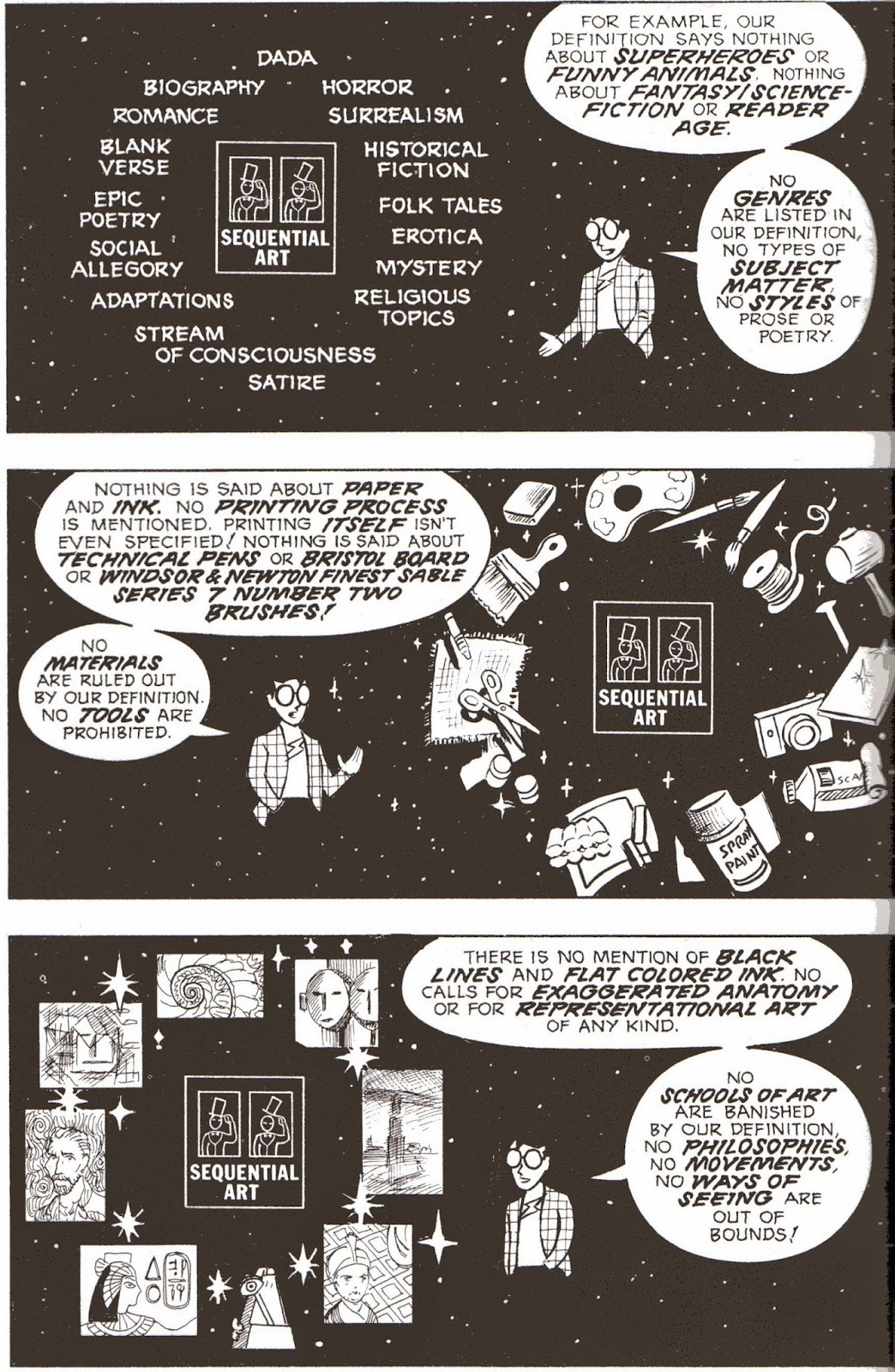
            A comic or graphic novel is not limited in medium or genre. That’s what graphic novelist Scott McCloud believes as he wrote in the first chapter of his book Understanding Comics: The Invisible Art that a comic could be done in pencil, ink, painted, sketched with pastels or charcoal. In addition, a comic’s content is not strictly just about superheroes or B-movie plots, but can feature a wide range of genres like fantasy, science-fiction, historical dramas, mystery, epics, social commentary, etc. There is no limit. Later in his book, McCloud discusses the idea of audience involvement, the idea of a novelist evoking sympathy to his or her audience based on the level of detail in their work. In this blog, I will discuss the ideas McCloud has on comics and how they apply to the graphic novel Fun Home by Alison Bechdel.
Loving father?
Pg. 18-19
            Fun Home is a memoir in graphic novel form that depicts Bechdel growing up in a small town in Pennsylvania. However, the novel is also a study of Bechdel’s father, her relationship with him, as well as coming to terms with her sexuality as a lesbian in the wake of his abrupt death, and how the events have altered her perspective of his character. McCloud makes a point that to the reader, a cartoon is merely a concept. McCloud’s comic book avatar declares, “Who I am is irrelevant. . . But if who I am matters less, maybe what I say will matter more (37). Bechdel’s memoir functions on a similar principle for I, as a reader, have no idea who Bechdel’s father was, I have never met him, and I have no chance to meet him now. He exists as a concept in her novel, the only record of his existence, and it’s up to me as a reader to judge him based on that.
 
Seriously. Why should I listen to a
three dimensional man?
Pg. 36
The cartoon man looks way
more trustworthy.
Pg. 37


Bechdel often includes detailed
sketches based on actual photos
to enhance realism. She's also noting
the similarities she and her family
share with the Addams Family, and
how much she resembles Wednesday.
 Pg. 35
However, because the only record of Bruce Bechdel is through his daughter, this creates bias in his depiction, a graphic form of the unreliable narrator. Bechdel recalls an oppressive atmosphere growing up because of her father’s obsessive hobby of restoring the family manor and filling it with “beautiful” things. She hated the experience and the environments in the house contrast to other set pieces in the narrative, in which scenes that take place in the manor are highly detailed to emphasize the exquisite beauty her father was obsessively determined to display while to her (and the reader) it was represented as gaudy clutter as opposed to the simplicity in places like her grandmother’s place or the funeral home. McCloud comments, “while most characters were designed simply, to assist in reader-identification––other characters were drawn more realistically in order to objectify them, emphasizing their “otherness” from the reader” (44). As an examination of her father, the detail on him and the manor allows Bechdel to establish the resentment she harbors but also her father’s closeted homosexuality.
 In addition, it allows us to perceive him as an alien figure just as Bechdel viewed him while growing up, considering that the cartoon avatar of her late father displays very little emotion, or positive ones at least. Even when Bechdel provides a flashback of her father’s childhood based on a story her grandmother would often retell, he was still stoic.
Pg. 40-41
            The idea that the level of detail can evoke an audience sympathy can be rooted in the theory of the Uncanny Valley, in which the more human attributes we give to a non-human thing, it becomes off-putting once it’s reached a certain point. While the principle has its similarities, it still does not function that way. Nevertheless, we see how Bechdel sees her father, as she uses simplicity to show peace and happiness and detail creates conflict. In addition, the father is a concept to us and he is defined by what Bechdel provides us with, including material that she was not witness to and had to work through speculation.
Bechdel walking in on her father
preparing a corpse for a funeral.
The nakedness and gore was an
uncomfortable memory for her.
Pg. 44-45
Works Cited
Bechdel, Alison. Fun Home. Boston: Mariner Books, 2006. Print.
McCloud, Scott. Understanding Comics: The Invisible Art. New York: Harper, 1993. Print.


Saturday, January 17, 2015

Strange Geometry: Structure of "The Girl Who Would Be Death"

Death's favorite movie is Mary Poppins.
Who knew?
Link
            Before I start this blog, I wish to establish that I love Neil Gaiman and his works. I discovered his writing when I was a junior in high school, my first novel by him titled Anansi Boys, and since then I’ve remained a fan and regard him as a major influence to my writing. I’ve started reading his most famous work, the Vertigo series The Sandman, as I was just starting college and took me two years to read through the saga’s eighty-two issues (eleven compiled volumes, including EndlessNights). Now I’m in my senior year and for my Graphic Novel class, every person is to analyze the structure of a random comic. What was the deliberate use of frames and panels? How do the frames enhance the story? Coincidently, I was assigned The Girl Who Would Be Death #3, the third act of a four part spin-off series created by Caitlin R. Kiernan and Dean Ormston. The cover lacked anything that would indicate Sandman or Dave McKean’s signature art style despite the word “Death” and the Vertigo logo. I joked while receiving the copy to look at, “I only know of one Death and this doesn’t look like her.” As it turns out, the story does take place in the Sandman universe as Gaiman was credited as a consultant.
Link
            Death, especially Gaiman’s Death, is one of the most well known and beloved characters in the DC Universe. Despite what her name and function implies, she is one of most loving and caring figures you could or ever want to meet, especially at the stressful and difficult moment of one’s own expiration. I say this because the cover is non-indicative to her character. The past covers by Dave McKean that have featured Death feature a dark and ethereal Goth girl. The cover of “The Girl Who Would Be Death” is more indicative of a horror/thriller title, which is not what the character is about. After skimming through the issue looking for candidate pages for this blog, I kept wondering at why I haven’t heard of this title because I’ve encountered all the other spinoffs. After googling it, there’s very little information about it and the comic book website, Comic Vine, lists the series as having poor reception since it’s release and is largely forgotten. That’s never a good sign. Beforehand, after skimming through, I was disappointed to find nothing that resonated with its source material. After seeing the review on Comic Vine, I realized that my feelings were founded. 
Because of the context of the assignment, I am not aware of what happened in the previous two issues and I could not read the comic because of A) the short amount of time in class and B) the issues are not to be taken home. This is purely going to be a superficial reading on how the creators structured the narrative.
            The first page opens with an establishing shot of two women sharing a bed while encircled with some sort of substance. It seems the creators are taking a page from the Sanderson Sisters’ spell book on protection spells; the circle is also made of salt, then that’s just plagiarism. Nevertheless, the page indicates that these women have had a rough night considering they had to draw a circle around where they sleep and the bars from the window and headboard convey this prison-like imagery. It’s to suggest that these women are struggling; they are trapped and cornered by an unseen entity as well as shocking to first time readers into wondering what led to this moment. From a strayed observation, could these women have any relation to Hazel and Foxglove, the lesbian couple from The Sandman?
            The first page is also the first instance of the creators’ use of panels overlapping a bigger picture, which is used repeatedly throughout the issue. I think the technique is used to depict the idea that everything is happening at the same time, several elements are in motion that are leading to a result. On this page, a man sees a raven [Matthew?] flying and then crashing into the window of these women. This event is very frightening to them and it seems like it’s trying to bait them out of their circle. I don’t know why, but the overlapping technique on the raven in the middle of the splash page is off, like it’s superfluous and comes off as obstructive and lessens the terror this thing is suppose to give off.
            The overlap technique is used again when a zombie-like figure appears in the narrative. Like the raven, it’s a little distracting, but I think the intention was to give weight to the appearance of this thing, considering that the women are frightened over their current situation and this creature appears and breaks through their defenses.
The Sandman is always known for giving characters, especially the Endless, unique word balloons like Dream’s/Morpheus’ inverted black and white wavy word balloons, Desire’s sharp lettering, or Delirium’s colorful word balloons. This zombie has a wavy, oozing word balloon reminiscent of the fonts used in slasher films just to reinforce this creature’s horror. I’m curious as to whether this story takes place after the events of the source material because [SPOILER] Morpheus dies. Can an Endless leave behind a corpse? I don’t recall Morpheus leaving one for his funeral. Nevertheless, the creature is similar looking to Morpheus along with his speech bubble and accompaniment of a raven.
The last page I chose was for this one panel, which effectively conveys the character’s emotional state. The most effective way to show someone lost and alone is to have them isolated, which is what the artist did by having this character isolated in this white void with her shadow stretching farther than physically possible. Most human characters who encounter the Endless have their lives changed, they often go on living trying to forget the experience like it was a dream or they go mad from knowing their world had gotten a bit bigger than they care to know. The isolated woman suggests the latter category. Something this simple can say a lot.
God made the world in seven days.
Dream unmakes it in seven minutes.
Link
“The Girl Who Would Be Death” is a weak entry in The Sandman universe because it’s trying to be something that it’s not. The issue contains other monstrous creatures and bits of horror to the point it seems like a different story. While the source material has plenty of horrific elements, to this day I still can’t get over “24 Hours” in Preludes and Nocturnes, that’s still not the overall focus of the narrative. The Sandman was an introspective, post-modernist fantasy that examined the nature of story, myth and the nature of dreams itself. The series has boasted beautiful, surrealistic artwork and probably the most fantastic sequence was in A Game of You, when Morpheus, in a majestic display of his power, “unmakes” a fantasyland with ease.
Death’s character seems inappropriate to be part of a horror title. It seems like the title was given to lesser hands, who then tried to reverse engineer what worked in the source material but only resulted in failure. It’s like giving TheNightmare on Elm Street to mediocre slasher film directors or having the TV show Community taken away from its creator, Dan Harmon, and given to mediocre show runners. The metaphor would be half-effective if it weren’t true and both products turned out sloppy.


Monday, November 3, 2014

SFX Zombie Graveyard Projections

            For my next project in special effects is a short featuring zombies rising from the grave. I can either use clips of graveyards supplied by my professor or collect clips for myself on my own time. I think I’ll do a mix of both. For a while now I’ve thought of making a zombie music video short using the song “Radioactive” by Imagine Dragons. While their official music video is cool, I just could never understand how the lyrics translate into a dog/cock-fighting ring with puppets–or should the term be sockfighting? I digress. Nevertheless, whenever I listen to it, I just think of this scenario involving a zombie apocalypse and I think this assignment will give me the opportunity to produce it. This is partly the reason why I would use clips supplied by the class and some of my own.

            My story involves a girl visiting a graveyard carrying books on dark magic. She is going to attempt to resurrect a lover of hers, who unfortunately died an untimely death. The spell worked . . . a bit too well. And the result is a mass of zombies rising from the grave to wreak havoc and unleash a zombie apocolypse. 
            Before I begin this project, I think I should dwell on the potential pitfalls I would have in making it. First, in the past I’ve had this pattern, this tendency to think up high-concept projects and failing to deliver when the due date arrived. I partly attribute this to my congested schedule and choking on other assignments due around the same time. Completing this project will probably be no different because in the next few weeks my schedule is going to be very tight.
            If I were, however, able to get started on my project, this is what I should consider. I need to find a working camera. I’m not sure if my school’s library now has them available on loan, especially after my attempt from my first video project for music video class. Nevertheless, I need a camera and actors to film the parts storyboarded as well as the actions depicting typical zombies rising from the grave. Finding actors should be tricky, as I’ve never garnered a large circle of friends. I wonder, however, if the friends I do have could introduce me to their other friends that might interested. I’ll see how well this plan turns out.
            Next is scheduling when shooting dates. Like I have mentioned, my schedule is tight for the next few weeks, and I’m sure some of the actors are in similar situations in addition to having jobs. In order to effectively film, we have to schedule proper meeting times.
            Part of the project is utilizing Adobe After Effects to implement certain effects into the short. Including but not limited to rack effects, turning night into day, flashlight effects, figures rising from the ground, masking, type floating into space, and green screen/rotoscoping. Half of these I know how to do well such as masking and potentially turning day into night and flashlight. Some skills I still need to learn such as green screen and making a figure rise from the ground. And some skills that I’ve started to learn but unsure that I’ve attained mastery over, namely rack effects. 

            However, in the event that this project is too complex for me to complete on time or I’ve just bitten more than I can chew; I could just forgo the narrative aspect completely. The second page of storyboards are just vague ideas based on the supplied clips, I could easily start there instead of having to work from scratch.

Friday, September 12, 2014

You're A Wizard, Harryhausen!

Ray Harryhausen is a household name in Hollywood, stop motion animation, special effects, and most nerd and geek inner circles. Originally inspired by King Kong, a young Harryhausen took up stop motion animation and experimented in his garage during his adolescence, creating his own puppets and sets with the help of his parents. He then started creating his own shorts based off the Grimm Fairy Tales. It was a dream come true when Harryhausen was hired to work on a spiritual successor to the film that inspired him, Mighty Joe Young, and would inspire generations after, with his work.
            I know who Harryhausen is, was, and the impact he had on cinema. To be honest, at the time of this writing, I am twenty-two years old and I have just started watching his movies, my first being the 7th Voyage of Sinbad. Scandal! Nevertheless, I can still explain who this man is and why he is forever mythologized as a genius, a Master of Creatures and a Special Effects Wizard.
            The most basic rule in animation is that it takes twenty frames to compose one second of animation. Most animated films today run at ninety minutes average, which would take 108,000 frames to make one animated film (not including the supporting cast and effects). The most frames that can be completed within one day are a few seconds, provided there are no mistakes. Modern animators accomplish this feat by dividing the workload among teams. Harryhausen, however, did all the animation by himself. One man animated less than 108,000 frames of animation by hand, as well as being heavily involved in the designs and production of the film.
            His dedication is comparable to Walt Disney as men who’ve tried to be technologically innovative in their field. Looking at his early fairy tale shorts, you could tell the amount of skill he put in his craft. For example, despite the crude facial animation in Hansel and Gretel, the characters' body language spoke volumes, especially the Witch, whose character oozed sinister intentions and feigned sweetness. I think I haven’t seen stop motion animation of this quality, especially in the Fifties, since the earliest stop motion features I could recall were the ones by Rankin/Bass, and they were crude. I think later stop motion animated films took notes on Harryhausen’s techniques as they acted and emoted with skillful quality.

             In special effects, I admire Harryhausen’s devotion in making his monsters believable. For example, despite a satyr nor a Cyclops exist in Islamic mythology, Harryhausen chose a Cyclops to be featured in the 7th Voyage of Sinbad because he wanted the challenge and he wanted the audience to know that it isn’t a man in a suit by giving the creature goat legs as well as three fingers on each hand. His techniques also included studying the animals that provide the basis for his creatures, like studying a gorilla for Mighty Joe Young and big cats for a saber tooth tiger in another Sinbad picture.
            The living skeletons remain Harryhausen’s signature creature. The first skeleton battle I’ve seen was the one featured in Sinbad. First the skeleton was summoned and would hang and bob around like a puppet. Then it would come alive and take a solid stance, ready to fight. What made the sequence, as well as the one featured in Jason and the Argonauts, stand out was animating the puppet to move in a choreographed fight sequence with a living actor and affect its environment. Occasionally the puppets would leap over the actors, instead of around them; a feat that would be difficult to pull off.
We got a bone to pick with you.

Harryhausen (center right), Peter Jackson (right),
John Landis (center left), Rick Baker (left).
            Harryhausen remains a legend of Hollywood cinema because of the artistic integrity he has done with his craft. In today’s world where special effects are mostly done through CGI and completed across various companies rendering it, they all lacked the intimate craftsmanship. In addition, special effects is seen as a form of magic trick, and Harryhausen was a great magician; there are some tricks FX artists have been trying crack for years. King Kong inspired one man to be the father of special effects, this one man inspired the imagination of generations of dreamers and artists.